
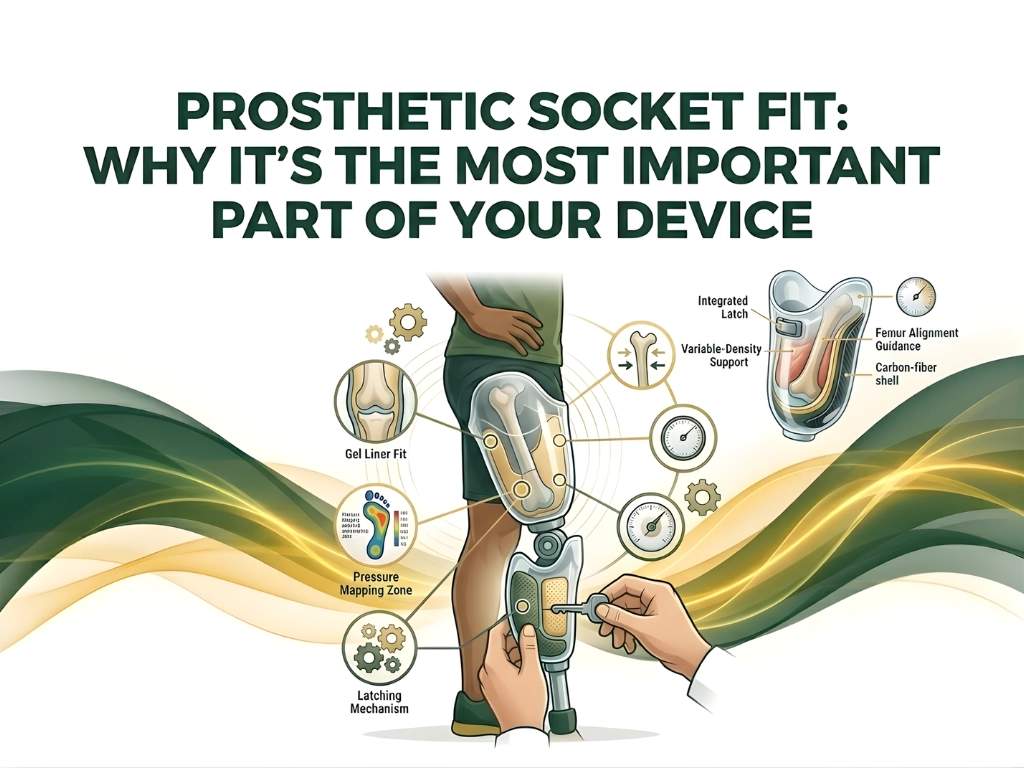
If you’ve ever worn a prosthetic limb, you already know that the socket is the part you think about most — because it’s the part you feel constantly. It’s the interface between your body and your device, and when it fits well, everything else falls into place. When it doesn’t, nothing works the way it should.
At Ropp Orthopedic Clinic, we talk about socket fit with every single patient, every single appointment. Not because it’s a box we check, but because we’ve seen firsthand how a properly fitted socket changes lives — and how a poorly fitted one can derail even the most motivated person’s rehabilitation journey. This article breaks down why the prosthetic socket is the most critical component of your device, what goes into getting it right, and what you should know as a patient or caregiver.
What Is a Prosthetic Socket?
The prosthetic socket is the custom-shaped cup or housing that connects your residual limb to the rest of your prosthetic device. Think of it as the foundation of a house — every other component, whether it’s a microprocessor knee, a carbon fiber foot, or an activity-specific attachment, depends on that foundation being solid and stable.
Unlike the other parts of a prosthetic system, which are often modular and interchangeable, the socket is built specifically for your body. It’s designed around the unique shape, volume, skin condition, and biomechanics of your residual limb. That customization is exactly what makes it both the most important component and the most technically demanding one to get right.
The socket must do several things at once: distribute weight evenly across your residual limb, maintain a secure suspension so the device doesn’t shift during movement, protect sensitive tissue and bony prominences from pressure damage, and allow efficient energy transfer between your body and the prosthesis. That’s a significant amount of work for a single interface to accomplish.
Why Socket Fit Affects Everything Downstream
Here’s something that doesn’t get said enough: a technically advanced prosthetic foot or knee cannot compensate for a bad socket. You can have the most sophisticated microprocessor-controlled components on the market, but if the socket doesn’t fit correctly, the entire system breaks down. The energy return from a carbon fiber foot gets lost. The gait training you’re doing in physical therapy becomes harder to translate into real-world function. Your confidence drops, and so does your activity level.
Poor socket fit creates a cascade of problems. When the fit is off, patients compensate with altered gait mechanics. Those compensations put stress on the lower back, the contralateral (sound) limb, and the residual limb itself. Over time, that stress adds up. Back pain is one of the most commonly reported long-term complications among prosthetic users, and improper socket fit is a major contributing factor that often goes unaddressed.
On the flip side, a well-fitted socket allows you to move naturally, confidently, and efficiently. It reduces the cognitive load of managing your device — instead of constantly adjusting, checking, or worrying about slippage, you can focus on where you’re going and what you’re doing. That shift, from managing your prosthesis to simply using it, is what rehabilitation is ultimately working toward.
The Variables That Make Socket Fitting Complex
Residual Limb Volume Fluctuation
One of the most underappreciated challenges in socket fitting is that your residual limb changes in size throughout the day and over time. In the morning, after a night of rest, your limb may be slightly larger. After hours of activity, fluid shifts can cause it to shrink. Factors like diet, hydration, heat, cold, physical activity, and even medications can all influence limb volume on any given day.
This means a socket that fit perfectly at your last appointment might feel loose or tight today — and both of those are real problems. A socket that’s too loose allows the limb to “piston,” or move up and down inside the socket, which causes skin breakdown, reduced control, and inefficient gait. A socket that’s too tight creates pressure points, cuts off circulation, and causes pain that makes wearing the device difficult or impossible.
Many modern socket systems use linear-based suspension with locking mechanisms, pin systems, or elevated vacuum to manage these fluctuations. Volume management strategies, such as adding prosthetic socks with graduated ply thicknesses, give patients some ability to self-adjust day-to-day. But none of those solutions replace the underlying importance of having a well-fitted socket as the starting point.
Bony Prominences and Soft Tissue Distribution
Every residual limb has areas where bone lies close to the skin surface. The fibular head, tibial crest, distal tibia, and ischial tuberosity are common pressure-sensitive landmarks depending on the level of amputation. The socket must be carefully shaped to relieve pressure over these areas while still providing adequate total contact and load-bearing support through the appropriate soft tissue regions.
This is where prosthetist skill and experience matter enormously. Identifying where to build in relief and where to apply pressure is part science, part art. It requires a thorough understanding of anatomy, hands-on assessment, and close communication with the patient about exactly where they feel discomfort.
Skin and Tissue Health
The condition of your skin and underlying soft tissue directly affects how well a socket can fit and how long you can wear it comfortably. Scar tissue, skin grafts, neuromas, heterotopic ossification, and previous pressure injuries all create fitting challenges that require thoughtful accommodation. Patients with diabetes or peripheral vascular disease face additional risk because skin integrity is already compromised, making proper fit not just a comfort issue but a health and safety issue.
How Prosthetists Evaluate and Achieve Proper Fit
The Casting and Scanning Process
Achieving a proper socket fit starts with accurately capturing the residual limb shape. Traditional plaster casting, along with increasingly common 3D scanning technology, allows the prosthetist to create a precise model of your limb in the optimal loaded position. The goal is not just to capture the resting shape of the limb, but to understand how it deforms under weight bearing — because that’s the condition the socket needs to address.
At Ropp Orthopedic Clinic, this process involves much more than a single measurement session. It includes a thorough clinical evaluation of your range of motion, strength, skin condition, activity goals, and lifestyle demands. A socket designed for someone who walks around the house a few times a day looks different from one designed for someone who works on their feet for eight hours or wants to return to hiking or running.
Check Sockets and Iterative Fitting
Before a definitive socket is fabricated, a transparent or semi-transparent test socket — called a check socket — is typically made and fitted first. This allows the prosthetist to directly observe how the residual limb sits inside the socket, identify any areas of excess pressure or poor contact, and make modifications before committing to final materials.
This iterative process is not a sign that something went wrong. It’s a sign that the fitting is being done properly. Rushing to a definitive socket without adequate check socket evaluation is one of the most common reasons patients end up with poorly fitting devices.
Dynamic Alignment and Gait Analysis
Socket fit isn’t evaluated only in static standing. How the socket interacts with your limb during walking, turning, sitting, and transitioning between surfaces tells the prosthetist a great deal about whether the fit and alignment are working correctly. Dynamic alignment adjustments fine-tune the relationship between the socket, pylon, and foot/knee to optimize your gait pattern and reduce compensatory movements.
Signs Your Socket Fit Needs Attention
Patients sometimes tolerate poor socket fit because they assume discomfort is just part of using a prosthesis, or because they don’t want to “complain.” This is worth addressing directly: discomfort is not something you should simply accept. A well-fitting socket should be comfortable throughout your typical wear schedule. If it isn’t, that’s clinical information your prosthetist needs.
Watch for these signs that your socket fit should be evaluated:
- Skin redness, irritation, or breakdown that doesn’t resolve within 20 minutes of removing the prosthesis
- Pistoning or a feeling of the limb moving up and down inside the socket during walking
- Visible gait changes, such as a lateral trunk lean or shortened step on the prosthetic side
- Pain at the end of the residual limb, especially after longer periods of activity
- Clicking, grinding, or noise during the gait cycle that wasn’t present before
Any of these signs warrants a call to your prosthetist. Many fit issues are correctable with relatively minor modifications — padding adjustments, liner changes, trim line modification — when they’re caught early. Left unaddressed, they tend to worsen and can lead to skin breakdown, infection, or the development of chronic compensatory pain.
The Role of Technology in Modern Socket Fitting
Prosthetic socket technology has advanced significantly over the past decade. Computer-aided design and manufacturing (CAD/CAM) systems allow prosthetists to digitally modify socket designs with greater precision and repeatability. 3D printing has enabled the fabrication of lightweight check sockets and even definitive sockets for certain patients more quickly than traditional lamination methods.
Elevated vacuum suspension systems actively pull the residual limb into the socket and maintain that contact through dynamic movement, which reduces pistoning and improves proprioceptive feedback — essentially your sense of where your limb is in space. For active patients, this technology can make a meaningful difference in how natural the prosthesis feels during high-demand activities.
That said, technology is a tool, not a shortcut. The most advanced fabrication system in the world still depends on an accurate clinical assessment, skilled modification, and thorough patient communication to produce a socket that truly fits. The human element of prosthetic fitting remains irreplaceable.
What You Can Do as a Patient
Your prosthetist needs your input to fit your socket well. Being specific about where you feel pressure, how the fit changes throughout the day, and what activities you’re having difficulty with gives your care team the information they need to make precise improvements. Vague feedback like “it doesn’t feel right” is a starting point, but the more detail you can offer, the faster the fitting process moves toward a comfortable, functional outcome.
Keep a simple log of your wear time, any discomfort you notice, and skin conditions you observe when you remove the prosthesis. This kind of record is genuinely useful in clinical appointments and helps your prosthetist identify patterns that might not be apparent in a single visit.
Also, don’t skip follow-up appointments when your limb is changing. The period immediately after amputation, and again if you experience significant weight change or illness, is when limb volume fluctuates most. Regular monitoring during these windows is the most effective way to stay ahead of fit problems before they become serious.
Conclusion
The prosthetic socket is not just one component among many — it’s the component everything else depends on. A well-fitted socket enables natural movement, protects your residual limb, supports your long-term musculoskeletal health, and gives you the confidence to fully engage in your life. A poorly fitted one creates a chain of complications that no advanced component technology can fix.
At Ropp Orthopedic Clinic, our approach to socket fitting is built on thorough clinical evaluation, patient-centered communication, and the iterative attention to detail that yields lasting results. If you have questions about your current prosthetic fit, are experiencing discomfort, or are beginning the process of getting your first device, we’re here to help. Reach out to our team at roppclinic.com to schedule an evaluation — because getting the fit right isn’t optional, it’s everything.